
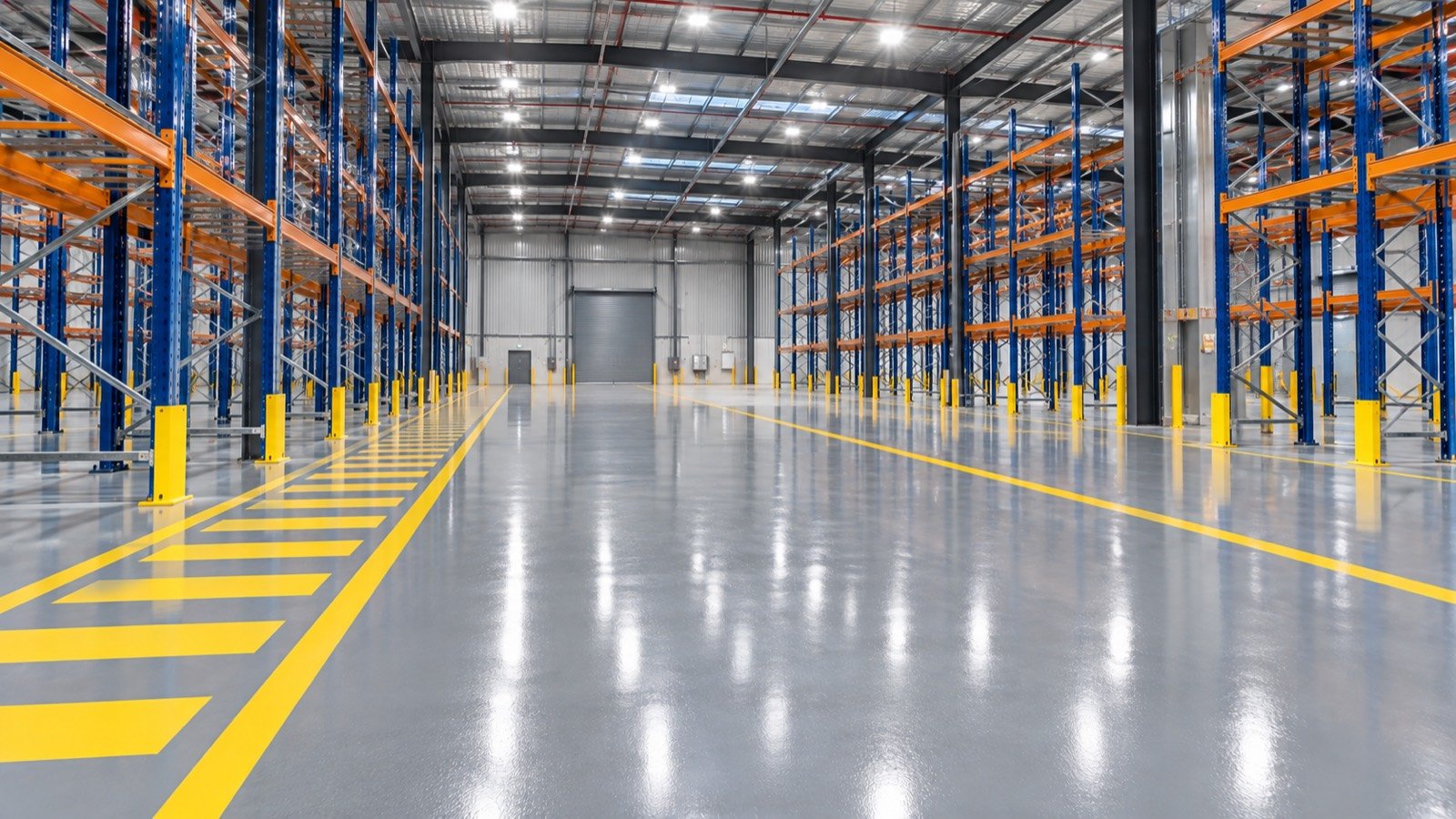
Coating a Live Warehouse Without Stopping Work
Commercial · 29 Sep 2026
The main reason warehouse owners put off a new floor is the fear of shutting down for a week. In most cases you don't have to. With planning, a working warehouse can be coated in stages while stock keeps moving. Here's how it's usually done.
Split the floor into zones
We map the warehouse into zones that can be closed one at a time: an aisle run, a dispatch bay, a picking area. Each zone is prepared, coated and cured before the next one starts. Stock and forklift routes are moved around the zone being worked on. The key is agreeing the sequence with your operations team up front, so nobody is surprised on the day.
Work when you're quiet
Much of the disruptive work, especially grinding, can be scheduled for nights, weekends or your quietest shifts. Coating the zone at the end of a Friday gives it the whole weekend to cure before traffic returns on Monday.
Dust and fumes
Preparing concrete properly means diamond grinding, and grinding makes dust. We use grinders connected to industrial vacuum extraction to keep it down, and seal off the work zone with barriers. For food, pharmaceutical or other sensitive stock, tell us early. Low-odour products and extra containment can be planned in.
Cure times: the part people underestimate
A coating being dry to the touch doesn't mean it's ready for a forklift. As a rough guide, which varies with the product and the temperature:
- Foot traffic: often the next day.
- Light vehicles and pallet jacks: usually a few days.
- Full chemical and heavy-load resistance: commonly around a week.
Cold weather slows curing. We'll give you the actual return-to-service times for the system we use on your floor before the job starts, so you can plan around them.
Racking, bollards and fixed equipment
Moving pallet racking is expensive and often unnecessary. We coat up to and around racking bases, and cut in carefully around bollards, dock levellers and fixed machinery. If racking is due to be moved or re-laid anyway, it's worth doing the floor at the same time.
Line marking goes on last
Once a zone has cured, walkways, forklift lanes, pedestrian crossings and pallet bays can be marked. Doing this as each zone finishes means the warehouse has safe, marked traffic routes as soon as it's back in use.
What to have ready before the site visit
- A floor plan, or a rough sketch with the main traffic routes.
- Your busiest and quietest days and hours.
- What is spilled on the floor: oils, chemicals, food, water.
- Which areas can never be closed, even briefly.
With that, we can put together a staged plan and a quote that shows exactly which areas are closed, and when.
Want a price for your floor?
Call 0470 347 292 or send us a few photos and we'll come back with a quote.
Free quote ↗More advice
- Concrete Resurfacing Cost in Sydney: Driveways, Paths & Pools
- Driveway Resurfacing: Is It Worth It? A Sydney Guide
- Pool Surround Resurfacing: Options, Colours & Costs
- Epoxy Flake vs Solid Colour: Which Floor Is Right for You?
- Can You Use Epoxy Outdoors? Why We Use Spray-Crete Outside
- Warehouse Line Marking: Planning Aisles, Walkways & Bays
- Epoxy Garage Floors: A Sydney Homeowner’s Guide
- Bunnings Epoxy Kit vs a Professional Garage Floor
- Epoxy Flooring Cost in Sydney: 2026 Price Guide
- Is an Epoxy Garage Floor Slippery? What Actually Helps
- Can You Epoxy Over Tiles? What Has to Happen First
- What a Food-Safety Auditor Checks in Your Kitchen Floor
- Getting Accessible Bays Right to AS 2890.6