
What a Food-Safety Auditor Checks in Your Kitchen Floor
Compliance · 29 Sep 2026
Most kitchen owners think about the floor twice: when it is laid, and when an inspector writes it up. The second one is expensive, because by then the floor is usually cracked, stained or lifting and has to be fixed around a working kitchen. Here is what inspectors are actually looking for, so you can check your own floor first.
The rule behind the inspection
In Australia, food premises have to meet the Food Standards Code, specifically Standard 3.2.3 – Food Premises and Equipment. For floors, it says they must be:
- able to be effectively cleaned,
- unable to absorb grease, food particles or water,
- laid so that there is no ponding of water, and
- as far as practicable, unable to provide harbourage for pests.
In NSW, your local council's environmental health officers inspect most retail food businesses, and the NSW Food Authority looks after licensed businesses such as meat, dairy and seafood processors. The wording they work from is the same.
What they check on the day
Cracks and chips. Any crack wide enough to hold grease or water fails the "unable to absorb" and "effectively cleaned" tests. Broken tiles and missing grout are the most common problem, because grout lines soak up fat and are almost impossible to clean properly.
The floor-to-wall joint. A square corner collects grime that a mop never reaches. Inspectors look for a sealed, rounded join, called coving, between the floor and the wall. The Australian Standard for food premises fit-out, AS 4674, calls for a coved junction, and a curve of at least 25 mm radius is the usual benchmark.
Water pooling. After a wash-down, water should run to the drain. Puddles that sit in low spots breed bacteria and are a slip hazard. Floors often sink or crack around drains, so that is where inspectors look first.
Peeling or worn coatings. A coating that is lifting at the edges traps water and dirt underneath it. A floor that has worn through to bare concrete in the walkways will absorb spills.
Gaps around equipment and penetrations. Holes where pipes, conduits or equipment legs meet the floor are pest highways. They should be sealed.
Why seamless resin floors pass
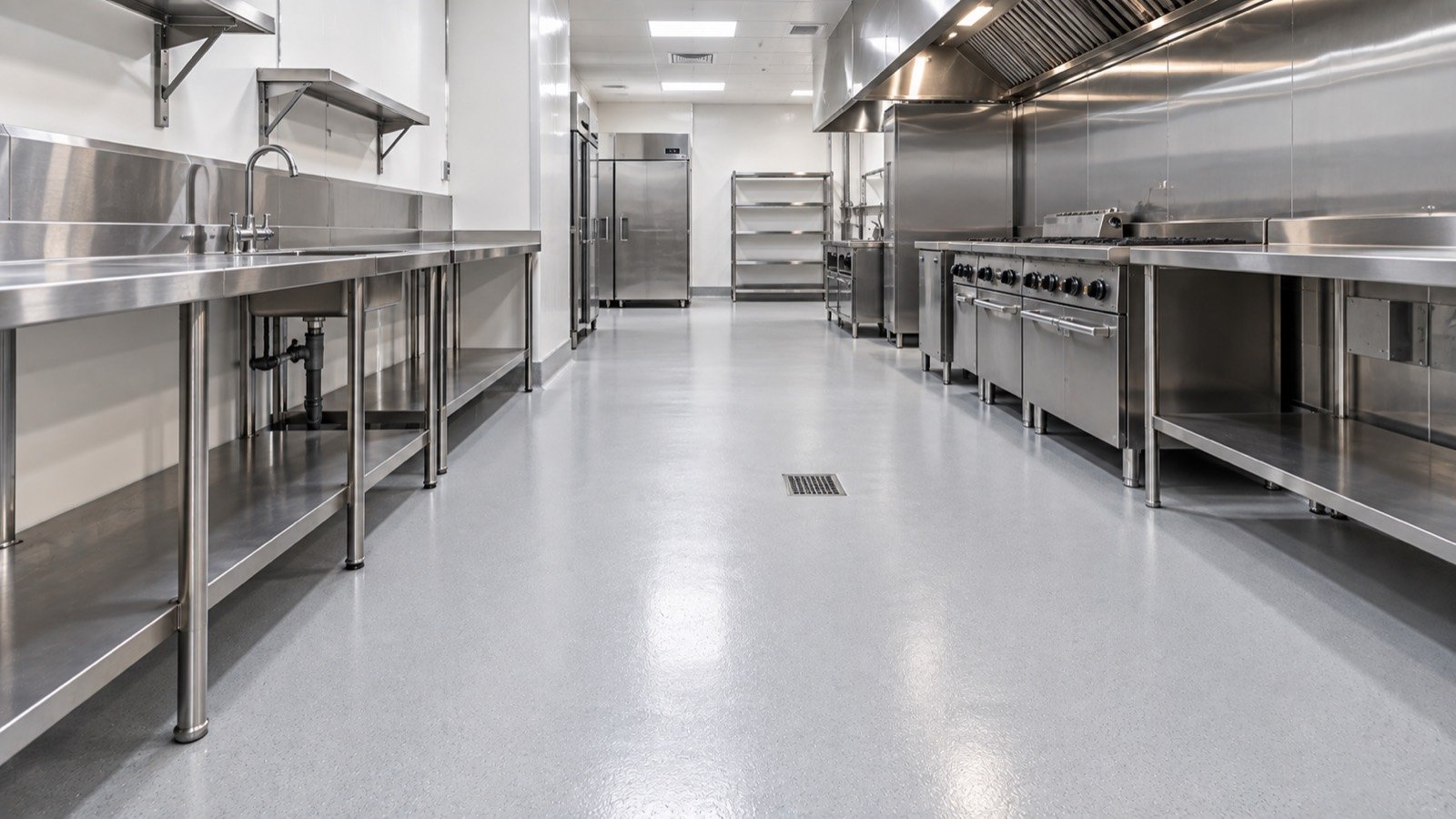
A properly installed resin floor, such as epoxy or a heavier-duty system in hot areas, is one continuous surface with no grout lines. It can be coved up the wall in the same material, so there is no joint at all at the floor-wall line. The surface doesn't absorb grease or water, and a non-slip aggregate can be broadcast into it so it stays safe when wet.
Not every kitchen suits the same system. Areas that see boiling water, steam cleaning or oil fryers need a coating rated for that heat and thermal shock. A standard thin epoxy can fail there. We'll tell you on site which system suits each part of your kitchen, rather than coating the whole room with one product.
Doing the work without closing for weeks
Most kitchens can't shut for long. The usual approach is to do the work over a weekend or a planned closure, preparing the floor by diamond grinding with dust extraction, fixing cracks and drains, and then coating. Cure times depend on the product and the temperature, so we give you a clear reopening time before we start, not on the day.
Quick self-check
- Can you see grout lines, cracks or chipped tiles?
- Is there a sealed, rounded join where the floor meets the wall?
- Does water sit anywhere after you mop?
- Is any coating peeling, bubbling or worn through?
- Are there unsealed gaps around pipes or equipment?
If you answered yes to any of those, it's worth fixing before your next inspection. Send us a few photos and we'll tell you what it needs.
This article is general information, not legal advice. Your council's environmental health officer has the final say on your premises.
Want a price for your floor?
Call 0470 347 292 or send us a few photos and we'll come back with a quote.
Free quote ↗More advice
- Concrete Resurfacing Cost in Sydney: Driveways, Paths & Pools
- Driveway Resurfacing: Is It Worth It? A Sydney Guide
- Pool Surround Resurfacing: Options, Colours & Costs
- Epoxy Flake vs Solid Colour: Which Floor Is Right for You?
- Can You Use Epoxy Outdoors? Why We Use Spray-Crete Outside
- Warehouse Line Marking: Planning Aisles, Walkways & Bays
- Epoxy Garage Floors: A Sydney Homeowner’s Guide
- Bunnings Epoxy Kit vs a Professional Garage Floor
- Epoxy Flooring Cost in Sydney: 2026 Price Guide
- Is an Epoxy Garage Floor Slippery? What Actually Helps
- Can You Epoxy Over Tiles? What Has to Happen First
- Getting Accessible Bays Right to AS 2890.6
- Coating a Live Warehouse Without Stopping Work